moms guide to a healthy body sm

Lifting your baby. Carrying a car seat. Holding your toddler in your arms. They can wreak havoc on your back, shoulders, and knees—unless you do them correctly. Here’s how.
 
When I became a parent, nobody told me how hard it would be—especially on my wrists, elbows, back and neck. In a word—ow! All the lifting, bending and twisting I do without thinking countless times a day to get my 8-month-old and my 3-year-old in and out of strollers, cribs, car seats and on and off changing tables is taking a physical toll in the form of creaky knees, achy elbows and a rebellious back.

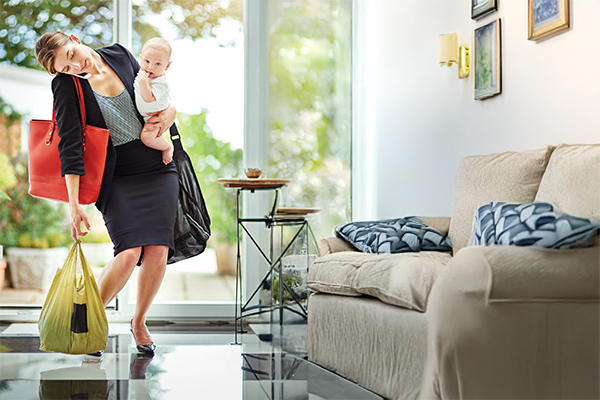
I’m far from alone. “I’m constantly treating moms who are suffering from repetitive-stress injuries (RSIs) that result from the wear and tear of being a parent,” says Peggy Brill, a New York City physical therapist and author of The Core Program (Bantam 2001). RSIs are degenerative disorders caused by chronically using poor posture to perform everyday tasks, such as carrying your baby in an infant car seat on your forearm like a handbag. Such poor body mechanics place too much force on ligaments, muscles, joints, tendons and spinal discs and can be harmful if you do them often. Women are especially prone to RSIs because, unlike men, they naturally lack upper-body strength.

Luckily, having good posture and learning how to lift and carry your child properly can reduce your risk of injury. With that in mind, here are five body-breaking moves and how to fix them.
 
Lugging an Infant Car SeatUse two hands to carry an infant carrier
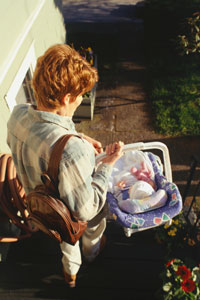
Don’t: Lean to the side and carry it on your forearm like a purse.

“This position stresses your back, shoulder, and—especially—that arm,” says Mary Ellen Modica, a physical therapist at Schwab STEPS Rehabilitation Clinics in Chicago.  “After my youngest child was born, I developed pain in my shoulders that wouldn’t go away,” says Sandy Cummings, a mother of three. “The doctor diagnosed it as bursitis.” The culprit: lugging around a 15-pound car seat with a baby inside.

“Carrying an infant car seat on your arm is equivalent to walking around with three or four full paint cans in one hand, something most people wouldn’t do, but yet, they’ll carry a car seat that way,” says Modica.
 
Do: Put both hands on the handle, bend your elbows, and carry the car seat in front of you. The less distance between your torso and what you’re carrying, the better for your back. Using both hands also helps distribute the weight evenly.
 
Lifting Your Baby From the Crib
Don’t: Lock your knees or hold your baby at arms’ length as you pick him up. “This puts extreme pressure on your spinal discs,” says Nicholas Warren, Sc.D., ergonomics coordinator at the University of Connecticut Health Center in Farmington.

Do: Plant your feet shoulder-width apart, lower the crib railing, and bend your knees. Then bring your baby as close to your body as possible before lifting him up.
 
Carrying a Toddler
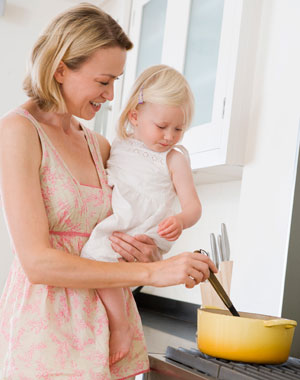
Don’t: Balance your child on one hip. This can strain your back and the ligaments on that side of the body. In addition, as your arm presses against your child, your muscles continually contract, reducing blood flow. Over time, this can lead to trauma of the tissues in your arm and shoulder.

Do: Hold her in front of you with her legs wrapped around your waist. Keeping your child centered will help you stand upright—your spine’s natural position. Another option: Use a stroller (or encourage your child to walk) as often as possible.
 
Putting Your Child on Your Lap
Don’t: Lean forward while you remain seated. Why?

“As you lift, the pressure on your spinal discs multiples to three to ten times the weight of your child,” Modica says. “If you’re tall, for example, lifting a 20-pound toddler from the floor could put as much as 200 pounds of pressure on your back!”

Do: Get down on one knee with the other foot planted in front of you, and hold her as you move back into your seat. Or you’re your child climb into your lap.
 
Lifting Your Toddler from a Car Seat
Don’t: do the twisted car seat lift.

Worst-case scenario: With both your feet on the ground, you twist and lean into the car seat with your arms extended, your toddler at the end of them. Lifting your toddler that way can do a number on your knees, lower back, neck, shoulder, elbows and wrists.

Do: “Put one leg into the car and face the car seat as you’re putting your child in it,” says Traci O’Hara, a physical therapist at Englewood Hospital and Medical Center in Bergen County, New Jersey. You’ll take pressure off your back. If your car seat is in the middle of the back seat, climb in and face the car seat as you lift your child into it. Of course, positioning yourself properly can take a few extra seconds you don’t always have with a feisty toddler in tow.

Still, “it doesn’t have to be perfect all the time,” says Dalton. “But the more often you lift correctly, the better you’re able to tolerate it when you don’t,” she says.
 
Get Strong!
Did you know that strengthening your abdominal, back, pelvic, and hip muscles can reduce your risk of developing a repetitive-stress injury? Physical therapist Peggy Brill recommends practicing this simple exercise at least three times a week.

Lie on your back with your arms straight up toward the ceiling. Keeping your back flat against the floor, lift your legs over your pelvis and bend your knees at a 90-degree angle.

In one slow, smooth motion, bring your left knee toward your chest as you extend your right leg. Keep alternating legs as you incorporate your arms: When your left leg moves toward your chest, extend your left arm over your head, and vice versa. Repeat up to a count of 60. 


Sandra Gordon is a freelance journalist and author.

 

Strategies to Prioritize Mama’s Mental Health and Happiness

Strategies to Prioritize Mama’s Mental Health and Happiness

  As a mom, the “mother load” can feel so heavy. How am I supposed to maintain a home, excel in a career, sustain friendships, be a loving wife, raise good humans and stay sane, let alone do . . .

Read more

Anxiety in Children: How to Identify Signs and Symptoms

Anxiety in Children: How to Identify Signs and Symptoms

As a parent, it’s natural to worry about the emotional well-being of children and teens, particularly when kids are navigating social and academic pressures, family stressors, the impacts of scree . . .

Read more

Health & Wellness Guide 2026

Health & Wellness Guide 2026

  Whether you set an intention or make a plan, resolution or commitment, consider adding fitness, outdoor activity and a healthy lifestyle to the new year. San Diego Family's 2026 Health &am . . .

Read more

Lessons from a Sweet Tooth: What Parents Need to Know About Sugar

Lessons from a Sweet Tooth: What Parents Need to Know About Sugar

I won’t sugar coat this—it’s not uncommon for recovering addicts to use sweets to combat cravings. Why? Because sugar activates the same pleasure and reward pathways in the brain as nicotine a . . .

Read more

How Nutrition Impacts Brain Health for Kids

How Nutrition Impacts Brain Health for Kids

  Did you know that one of the most powerful ways to support your child’s overall well-being is by understanding the role nutrition plays in brain health? What children eat directly impacts th . . .

Read more

What is Misophonia? How sound causes anger and frustration in kids

What is Misophonia? How sound causes anger and frustration in kids

Not long after my 12-year-old daughter had (what I thought was) an extreme reaction to the sound of me eating a sandwich, we discovered she has a disorder known as misophonia. Misophonia is a neurol . . .

Read more

31 Ideas for Family Wellness

31 Ideas for Family Wellness

  Prioritize wellness and self-care this year by establishing new habits that promote family health and help manage stress for yourself and the kids. There’s no need to feel overwhelmed by thi . . .

Read more

Check Your Family’s Mental Health and Where to Find Help

Check Your Family’s Mental Health and Where to Find Help

Mental health challenges among kids and teens have been on the rise, and in recent years they have skyrocketed. According to a recent joint declaration from the American Academy of Pediatrics, Ameri . . .

Read more

Pandemic Pitfalls: What to know about developmental delays in children

Pandemic Pitfalls: What to know about developmental delays in children

An interview with Tracy Tasker, MA, CCC-SLP In the wake of the COVID-19 pandemic, researchers have observed an increasing number of children with developmental delays. While the numbers are con . . .

Read more

The Secret to Family Fitness: Focus on Playtime!

The Secret to Family Fitness: Focus on Playtime!

According to The American Academy of Pediatrics (AAP), “Play is brain building, a central part of healthy child development, a key to executive function skills, and a buffer against the negative i . . .

Read more

How Digital Devices Affect Eyes: What you need to know about Computer Vision Syndrome

How Digital Devices Affect Eyes: What you need to know about Computer Vision Syndrome

Does your technology-fixated child ever complain of dry, irritated eyes? What about blurry vision, headaches, light sensitivity, neck and shoulder pain, or fatigue? You might look to his electronic . . .

Read more

How Nature Helps Beat the Winter Blues

How Nature Helps Beat the Winter Blues

San Diegans have some of the best weather in the country, but they are not immune to winter blues. While some people love snow trips and bundling up in warm clothes, others dread cooler weather and . . .

Read more

What’s the BUZZ: Are energy drinks safe for kids?

What’s the BUZZ: Are energy drinks safe for kids?

  Perhaps you saw in the news recently that Panera has been charged with two deaths associated with a drink on their menu called Charged Lemonade. While there were likely special circumstances i . . .

Read more

New Year, New Moves: Fun ways to exercise as a family

New Year, New Moves: Fun ways to exercise as a family

   Whether you have goals, resolutions, visions, mantras or targets for the New Year, one popular topic on people’s minds is exercise. And why not? In addition to helping prevent a slew o . . .

Read more

How to Keep Tabs on Stress and Anxiety in Kids

How to Keep Tabs on Stress and Anxiety in Kids

The pandemic created an undercurrent of anxiety that continues to impact families even while adjusting to working and schooling from home, wearing masks and social distancing. Combined with the unce . . .

Read more

2026 Family Fun Runs and 5K Events in San Diego County

2026 Family Fun Runs and 5K Events in San Diego County

Ready to start the year on the right foot? Here's a list of 2026 family fun runs and 5K running and walking events in San Diego County that the whole family can participate in. Get outside and have . . .

Read more

San Diego Cancer Support Groups and Resources

San Diego Cancer Support Groups and Resources

A cancer diagnosis is difficult for everyone involved. These local San Diego companies offer support and resources to help cancer patients and their families navigate the path to health and healing. . . .

Read more

How to Support Kids When a Parent Has Cancer

How to Support Kids When a Parent Has Cancer

Many people know how to help friends or family members who have been diagnosed with cancer or another life-threatening or chronic disease. But when the diagnosed individual is a parent who is increasi . . .

Read more

Teaching Kids About Money

Teaching Kids About Money

It's never too early (or late) for parents to teach kids about money. Specifically, to discuss saving, spending and borrowing money—and sharing our resources. According to Brad Benter, a fina . . .

Read more

How to Protect Kids from Anxiety Overload

How to Protect Kids from Anxiety Overload

Anxiety in kids is on the rise, and it doesn’t take too much digging to uncover some of the reasons why. With increased pressure inside and outside of the classroom, children’s performance is me . . .

Read more

Be Family Informed – Sign up for our Newsletters below!

Subscribe