get answers from a teacher sm

How to Stop Children from Being Quitters

Q:     How can I help my third grade son who just gives up at the first sign of difficulty? What can I do to help him stop being a quitter? – Cheerleader Mom

A:     Children usually start giving up after experiencing a cycle of failures at school. Your son is only in the third grade; he more than likely wants to do well in school. Very sadly, not all bright children succeed in school. Some begin tasks very halfheartedly and give up at the first sign of difficulty. Psychiatrists call this “learned helplessness.” It can happen in the early grades because of emotional immaturity, low frustration level or over-dependency on adults. It also can happen when children start fourth or sixth grades because these are points when learning requires more effort, and some bright children have no strategies for handling difficult assignments and give up too quickly. It’s not easy for these children to overcome the tendency to give up when the going gets tough, but they can with continued help from teachers and parents.

By modeling how to approach a problem and giving specific instructions at every step along the way, parents can help their children learn how to tackle difficult assignments. They will need to teach them:

  • Effective problem-solving strategies
  • To look for more than one approach when solving a problem
  • To retrace their steps to find errors
  • To use self-talk as a guide for solving problems.


Grades for Effort Do Matter 

Q:   My son receives a grade for both achievement and effort in every one of his subjects.  I am not sure which grade I should be most concerned with? Is it important to receive both grades for each subject? – Puzzled

A: The grades measure different things. The achievement grade reflects how well your son has mastered the subject material. The effort grade is less precise. It shows how hard your child is working including doing classwork, participating in class discussion, and completing homework assignments.

You should be most concerned about the relationship between the two grades. A good grade in effort should ideally be linked to a good grade in achievement. On the other hand, a poor grade in effort can often explain a low achievement grade. And a high achievement grade coupled with a low effort grade may indicate that a child needs more challenging work. Whenever there is a significant difference between the two grades, a discussion with a teacher should be arranged.

Research has shown that students’ beliefs about effort are very important. If students believe that the effort they put into learning an academic subject will lead to achieving a better academic grade, the students are more likely to put forth the necessary effort to obtain the results they want to achieve.


Help for 6th Grader Failing Math

Q:     My granddaughter failed math in sixth grade and got a failing grade the first semester this year in seventh grade. She hasn’t mastered multiplication, and her addition and subtraction skills are poor. She has just been passed along. The school did not have summer school, and the teacher is a poor communicator. I’m trying to work on helping her learn the basic facts. What else can I do? – Want to Help

A: The best thing that you can do right now is to see that the child gets the help that she so obviously needs. The individual responsible for this child, whether it is you or a parent, must immediately contact the school to see that help in math begins at once. It would be a good idea to meet immediately with this teacher. Find out why an intervention or testing for a learning disability has not been done.

If you do not receive a helpful response from the teacher, contact a counselor or the principal. This child’s skills sound so weak that an individual tutor or math learning center may be needed. Nothing but serious problems in math are going to occur in the future without considerable help. How will this child ever be able to handle math in high school to fulfill graduation requirements?

You can supply some help to your granddaughter. To work on addition and subtraction, use manipulatives (counters, coins, etc.) so she can actually see problems. If she is strong enough to work on multiplication, try this technique: For a problem like 3 x 4, have her draw three parallel vertical lines and cross them with four parallel horizontal lines and then count the intersections (12) to get the answer. You will also find it helpful to search on our website for math under the elementary level, as you will find a variety of suggestions about ways to teach basic math facts, starting with addition. Do not consider your granddaughter’s math skills strong in any area until she can solve basic addition, subtraction and multiplication facts in 3 seconds or less.

--------------------------------
Parents should send questions and comments to This email address is being protected from spambots. You need JavaScript enabled to view it. or ask
them on the columnists’ website at www.dearteacher.com. ©Compass Syndicate Corporation, 2013.

Published: February 7, 2013

Write on! Encouraging kids to put pen to paper

Write on! Encouraging kids to put pen to paper

Step aside, ChatGPT. We’d like to prompt today’s digitally driven youth to explore writing the old-fashioned way—by placing pen to paper. Increasingly, students are using generative AI to “w . . .

Read more

17 Ways to Celebrate National Literacy Month

17 Ways to Celebrate National Literacy Month

  It’s always an appropriate time to spotlight the importance of reading and writing skills, and especially during National Literacy Month in September. Below are 17 ways for parents, caregive . . .

Read more

Education Guide - Spring 2026

Education Guide - Spring 2026

Where to send kids to school is a big decision on every parent's mind right now. Our education directory features educational options in San Diego County with a variety of learning environments—pu . . .

Read more

New Career in a Year: Ideas for parents going back to school 

New Career in a Year: Ideas for parents going back to school 

Ready for a new career? Consider going back to school! The options below offer flexible learning (often at a reasonable price) that can launch parents and caregivers into a new industry in about a y . . .

Read more

How Reading and Storytelling Support SEL

How Reading and Storytelling Support SEL

  Did you know that interactive storytelling supports social-emotional learning (SEL) and the development of literacy skills? That’s right—sharing stories actually teaches children to build . . .

Read more

How to Choose a Private School

How to Choose a Private School

  If you’re thinking about enrolling your children in a private school, there are many important factors to consider. As an elementary school teacher who has taught at private schools (both in . . .

Read more

How to Get Organized Before School Starts + Routines Checklist

How to Get Organized Before School Starts + Routines Checklist

As you enjoy the last lazy summer days, it’s time to start thinking about the new school year. Regardless of what emotions that reality evokes for you, there are practical steps families can take . . .

Read more

Help Kids Develop Math Skills (even when math isn’t your best subject)

Help Kids Develop Math Skills (even when math isn’t your best subject)

I often wonder if my children will get my best or worst traits. From physical appearance to my affinity or disdain for certain foods, I marvel at how genetics works. When it comes to math ability, y . . .

Read more

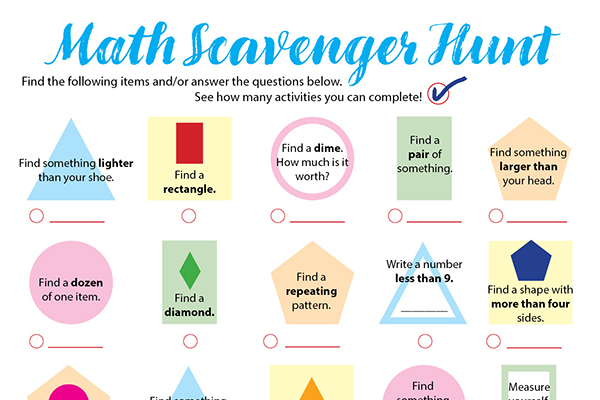
Math Scavenger Hunt for Kids

Math Scavenger Hunt for Kids

Have you ever been on a math scavenger hunt? San Diego Family Magazine created a free, printable math scavenger hunt to help families with kids ages 4–10 take note of patterns, numbers, shapes and m . . .

Read more

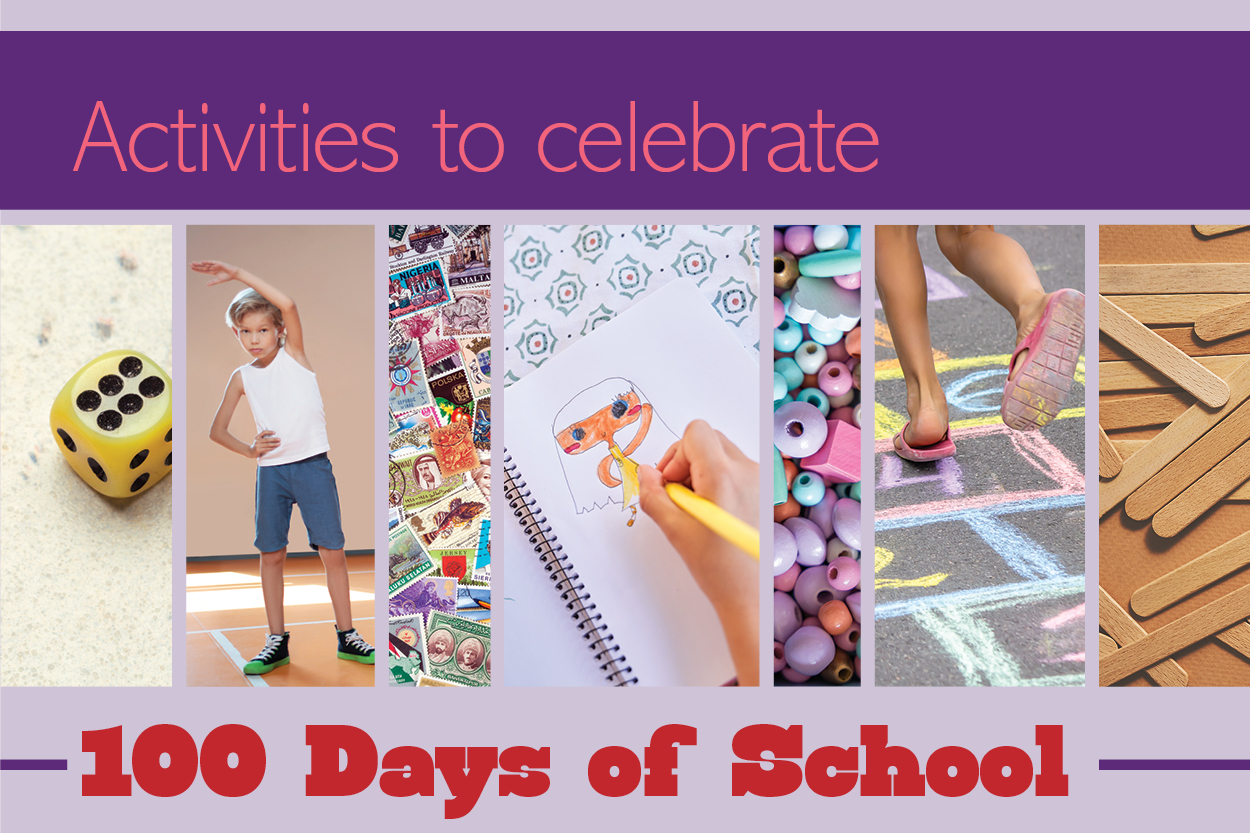
Fun Activities for Kids: Celebrate 100 Days of School

Fun Activities for Kids: Celebrate 100 Days of School

  The purpose of celebrating 100 days of school is to have fun while reinforcing reading, writing and math skills kids have learned so far at school. Plus, hands-on activities are what make lear . . .

Read more

Learning Outside the Box: Education Options for Families

Learning Outside the Box: Education Options for Families

As families seek flexible approaches to educating their kids, alternatives to traditional schooling have become more popular. From modern-day homeschooling to worldschooling, these education options o . . .

Read more

25 Activities that Help Kids with Math

25 Activities that Help Kids with Math

Is math homework giving you a headache? Do you dread hearing the words, “I hate math!” While math may not appeal to some children, it is helpful to everyday living, and strong math skills can op . . .

Read more

What’s Your Child’s Learning Style?

What’s Your Child’s Learning Style?

Most of us know that people learn in a variety of ways — perhaps you’ve noticed kids who count on their fingers, prefer to read aloud or always write things down. But did you know that there are . . .

Read more

Questions to Ask When Considering Private School

Questions to Ask When Considering Private School

It’s easy to conduct an internet search and find a multitude of links that list the best private schools in San Diego, but it’s important to understand that what’s best for one family or stude . . .

Read more

How to Find the Right Preschool

How to Find the Right Preschool

Choosing the right preschool is an important decision for parents. For some, it will be the first time a stranger will watch and care for their child. Here are tips to help make the right decision.C . . .

Read more

Raising Avid Readers

Raising Avid Readers

Raising readers offers a host of cognitive, behavioral and social-emotional benefits, including language development, increased vocabulary and improved attention span as children learn to process em . . .

Read more

Homework Help: Apps and San Diego Tutoring Services

Homework Help: Apps and San Diego Tutoring Services

After a year of online learning during the pandemic, many students fell behind and are still struggling to catch up. Every student needs homework help at some point—sometimes more support than a p . . .

Read more

Farmers Markets Offer a Bounty of Learning Opportunities

Farmers Markets Offer a Bounty of Learning Opportunities

Going to farmers markets on a regular basis puts fresh, seasonal produce at kids’ eye level. They start to notice that foods vary week by week and learn what’s in season. This offers an opportunit . . .

Read more

Be Family Informed – Sign up for our Newsletters below!

Subscribe