If you’re of a certain age, you may remember the days of landline phones—waiting at home for someone to call, an entire household sharing just one phone number, calling friends but their parents answering. Oh, and the only thing you could do on the phone was talk. There was no texting, browsing the web, posting on social media or playing video games. Now, with concerns about screen time and online safety, some families are revisiting this old-school technology with fresh purpose.
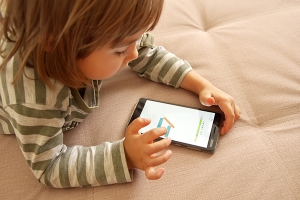
Research (and common sense) shows that smartphones have drawbacks, especially for kids—who are now getting their first phones at an average age of 11.6 (per Stanford Medicine). Smartphones expose children to inappropriate content, along with impacting physical health (sleep disruption, inactivity, vision problems) and mental wellness (impaired social skills, anxiety, depression).
A growing number of parents are choosing to delay smartphones for as long as possible, instead installing home phones (aka landlines) for their kids to communicate with friends and loved ones. This movement isn’t just a nod to nostalgia—it’s a calculated parenting decision.
What are the benefits of home phones/landlines?
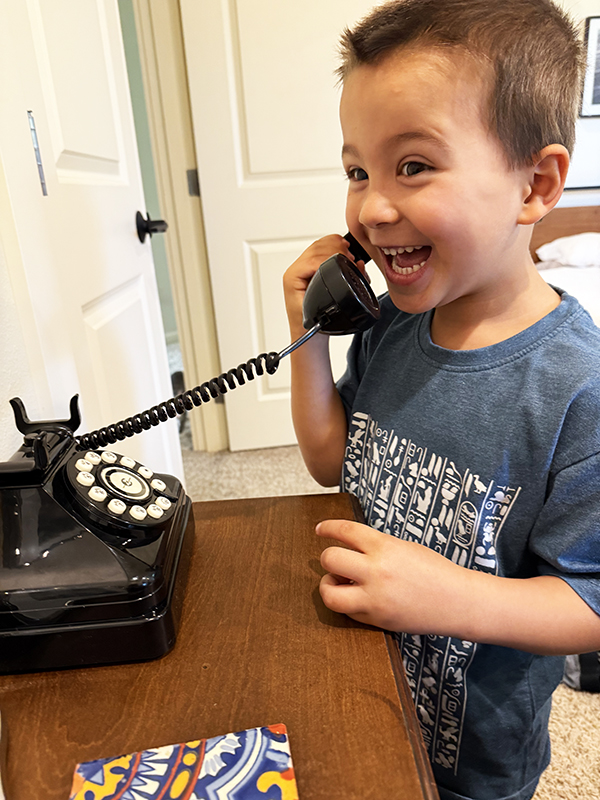
Home phones are a fun, “retro” way to stay connected. From a young age, kids can safely make and receive voice-only calls without exposure to screens or online content. Within this framework, they’re able to build relationships, improve conversation skills, increase responsibility and develop greater self-confidence. With smartphones out of the picture, it’s also easier for parents to encourage healthy behaviors.
When a close-knit group of parents agreed to install home phones for their kids to call each other, Ellie LaRue (mom of two, ages 5 and 6) quickly learned that young kids require phone etiquette lessons. “It's been fun to coach them through how to call someone and how to answer your own phone,” says LaRue. “It's a new frontier to teach manners and human connection.”
Michelle Headley, Rancho Bernardo mother of three (21,17, 10), explains her reasoning for delaying smartphones. “We did not want our kids to have open access to the internet at such an early age, see things that their young eyes were not meant to see, and be involved in chat groups/social media,” she says. Her family uses an internet-based home phone service, also known as Voice Over Internet Protocol (VoIP).
“I wanted my children to grow up more similar to our 80s/90s childhood where it was about play, exploration outdoors and socialization,” says Jill Smith, a Scripps Ranch mother of two (10 and 7). She hasn’t allowed the use of smartphones or tablets at home, but plans to provide basic cell phones for talk/text only when her kids reach high school.
“We installed a new VoIP landline last summer and it has been fun,” says Robin Franceschi of Poway. “The kids now take a more active role in planning their own playdates, and have a direct line to grandparents.”
Other benefits of landlines include superior call quality, greater reliability during power outages and a precise location for emergency responders. Both landline and VoIP phones often cost less than mobile phone services.
Other Considerations
Going retro sounds pretty appealing, but mobile phones provide peace-of-mind for some parents. For instance, it’s easier to check in with kids throughout the day. They can also always reach Mom or Dad. Many parents take comfort in using phone location tracking apps to monitor their child’s whereabouts, but there are other options, such as Apple AirTags (which can be tucked in a backpack or shoe) and AngelSense.
Parents who delay smartphone usage with their children understand that they’ll have friends who still have them. Without access to group chats, social media and online video games, your child may feel socially isolated—and will mostly certainly insist she is “the only person at the whole school without a phone.” Be prepared for pushback and do whatever you can to help kids stay connected in other ways. Remind them to call friends from the home phone, of course. Encourage in-person connections and get-togethers. Deeper friendships develop when smartphones are not part of the equation.
“It's hard when other parents give their kids phones at an early age and your child begs for a phone too,” admits Headley. Even so, she’s glad they held off until the teen years.
When Should Kids Get Smartphones?
Most experts recommend waiting until at least age 13 (eighth grade). Parents should consider their child’s level of maturity, responsibility and individual circumstances. Whatever age you decide is appropriate, establish clear rules and expectations—and have some serious conversations about internet safety, cyberbullying and toxic social media behavior.
“Once they get a smartphone, it's hard to go back,” Headley says. “Better to delay.”
Learn more about the “Wait Until 8th” movement at www.waituntil8th.org. When you do “take the leap,” consider creating a smartphone contract. Get ideas on how to do that at www.sandiegofamily.com/parenting/how-to-make-a-family-digital-citizenship-contract.
How to Install Home Phone Services
In California, analog phone providers are still required to provide traditional copper landline service, at least for now. But low-cost, digital VoIP services are widely available through telecommunications companies like AT&T, Spectrum and Ooma. Another provider, Tin Can, caters specifically to kids. Through a parents-only companion app, calling can be restricted to approved numbers only.
AT&T www.att.com/home-phone/landline
Spectrum Voice https://official.spectrum.com/sem/voice
Ooma www.ooma.com/home-phone-service/buy
Tin Can www.tincan.kids
Lisa Pawlak is an award-winning contributing writer living in Encinitas with her family.